An institutional visit can be the result of months of work. Yet sometimes, when it finally happens, what remains is not the result achieved, but what we discover by observing another person before history, faith and personal memory.
One of the first challenges
At the beginning of my role as Senior Advisor for Institutional Relations to the Mayor of Pompeii, Carmine Lo Sapio, he set me one of my first challenges: bring a Head of State to Pompeii.
It was an ambitious objective. Pompeii did not need to be introduced to the world; its name already crosses continents, languages and generations. Yet precisely for that reason, I thought it would be meaningful to imagine a visit that was not merely ceremonial, but capable of opening a relationship.
I still remember my answer to the Mayor: “What if we tried to invite Prince Albert II of Monaco?”
That was the beginning of a process far longer than the day that, many months later, would finally bring the Prince to Pompeii. It was made of conversations, waiting, institutional contacts and those moments when one simply has to keep working without yet knowing whether the result will come.
For part of that dialogue I was joined by a colleague in Pompeii who, sadly, is no longer with us. I like to remember him here too. Behind the appointments that eventually become public there is almost always an invisible story: calls, conversations, people who open a door, others who help keep it open, intuitions that at first are only possibilities.
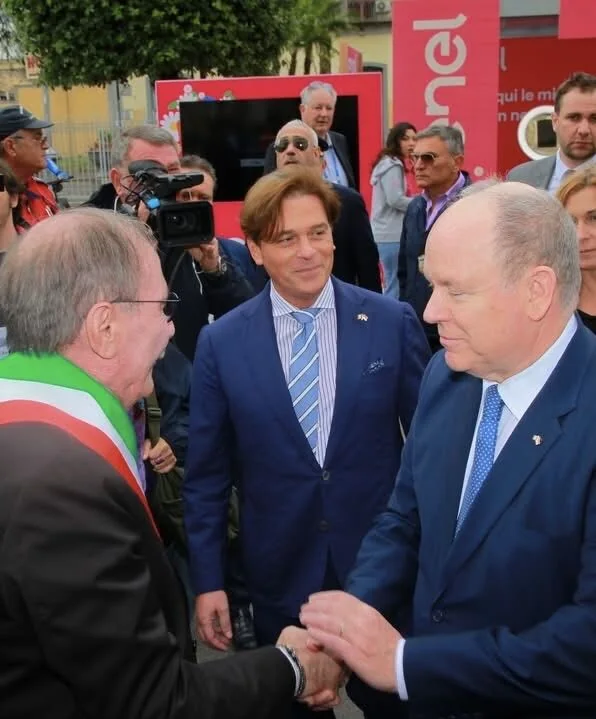
On 15 May 2025, when H.S.H. Prince Albert II of Monaco finally arrived in Pompeii and was welcomed by Mayor Carmine Lo Sapio, what appeared to many to begin that morning had, for us, begun much earlier.
For me it was also the fulfilment of one of the first challenges I had received at the start of my role. Yet during that day something happened that ultimately interested me even more than the institutional result we had achieved.
I had spent months thinking about how to bring the Prince to Pompeii. That day I began instead to observe how Pompeii was entering him.
The capacity for wonder
At the Archaeological Park, the Prince was accompanied by Director Gabriel Zuchtriegel through some of the site's most significant places and discoveries.
I found myself watching him. What struck me was his curiosity: the attention with which he looked at what was being shown to him, the ability to stop before something that had crossed almost two thousand years and still allow himself to be surprised by it.
Albert II would describe Pompeii as “magnificent, wonderful”. Those words matched what I had perceived while observing him.
A man born into one of Europe's best-known dynastic families inevitably grows up surrounded by history. Yet familiarity with history had not erased the capacity for wonder.
Perhaps culture begins precisely here: in the ability never to treat beauty as something owed to us.
Pompeii has another extraordinary quality. The catastrophe that destroyed it paradoxically helped preserve its memory. Since then, generations of archaeologists, restorers, scholars and workers have continued to bring it back to light.
None of them owns Pompeii. Each, for a portion of a lifetime, helps to safeguard it.
To receive is not to possess
We tend to think of inheritance as something that becomes ours: property, a house, a name, a patrimony. But perhaps the most important inheritances work in exactly the opposite way.
The greater what we receive, the less we can truly regard ourselves as its owners.
An archaeologist receives traces of people who lived two thousand years before. An institution temporarily receives responsibility for a territory. A community receives monuments, traditions, landscapes and knowledge. A family may receive a name and a history that cross centuries.
In each case we are only a passage. We receive something that existed before us and that, if we do our work well, will continue to exist after us.
The rarest privilege is not inheriting something. It is understanding the responsibility of having inherited it.
From this perspective, Europe's historic families can also be considered not as nostalgia for a past political order, nor as an assertion of social superiority, but as part of the complex continuity that helped shape European history.
Their cultural value, when safeguarded and shared, also lies in that continuity. Perhaps those born within such a long history can more readily understand how small the time granted to each of us really is.
From wonder to emotion
But the moment I remember most intensely came later.
Entering the Sanctuary of Pompeii, I perceived something different in the Prince. At the archaeological site I had seen curiosity, attention and wonder. In the Sanctuary I saw an even deeper involvement.
This is, of course, my personal impression — the memory of someone who had the opportunity to be there that day. But it was very clear to me.
The institutional dimension suddenly seemed to recede. The reason was profoundly personal.
Albert II had himself explained that his visit to Pompeii was also connected to his family's faith and, in particular, to his mother Princess Grace's devotion to Our Lady of the Rosary. In the Sanctuary he paused in prayer at the chapel of Blessed Bartolo Longo and attended Mass in memory of his mother.
At that point, everything I had observed during the day acquired a different meaning.
The Sovereign Prince. The Head of State. The heir to the Grimaldi family. A man raised within one of Europe's most recognisable dynastic histories.
For a few moments, before the memory of Grace, there seemed to be above all a son.
Few things could be more universal. Titles, offices and protocols may make human lives look profoundly different. The memory of a mother suddenly makes them much more alike.
What we inherit without noticing
It was perhaps in the passage from the archaeological site to the Sanctuary that I understood more clearly what that day could tell us.
In Pompeii we had encountered at least three different forms of inheritance.
The first was the inheritance of a civilisation: a city lost beneath Vesuvius and gradually returned to humanity through the work of generations.
The second was the inheritance of a family: the Grimaldi name, crossing centuries and inevitably carrying with it memory, places and responsibilities.
The third only appeared smaller: the inheritance of affection. A prayer recited by a mother. A devotion. A place that, many years later, still holds meaning for her son.
We tend to identify heritage with what we can see. Yet we also inherit things that cannot be placed behind glass. Gestures. Words. Habits. Responsibilities. Faith. Memories. We inherit bonds.
Humility before time
That day also made me think about humility. Not humility as a quality automatically attached to a title or social position; that would be a meaningless generalisation.
Rather, another kind of humility: the one that can emerge when we stand before something far greater than the duration of our own life.
Pompeii has this effect. Before those streets, a prince, a mayor, an archaeologist or any visitor shares the same condition. All arrived later. All will inevitably leave before Pompeii does.
Perhaps historical awareness serves this purpose too: to put the present into perspective without diminishing its importance.
Europe's true heritage is therefore not only the extraordinary beauty we have received. It is also the culture of continuity that should teach us how to treat it.
The people behind the result
Looking back now at the path that preceded the visit, this reflection on memory has a personal meaning for me as well.
Part of that long dialogue was shared with a colleague in Pompeii who accompanied me along the way and who is no longer with us.
When we look at an official visit, a signature or a photograph, we naturally remember what is visible. Yet behind almost every result there is a much larger human geography.
There are people who had an intuition, made a call, found the right contact, solved a problem, or accompanied a project for only part of its journey.
Not all of them will appear in the final photograph. Not all will be mentioned in official accounts. But that does not mean they are not part of the history of what happened.
The people who walked with us also become part of what we inherit.
Inheriting time
When I think back to 15 May 2025, I naturally remember the satisfaction of seeing one of the first challenges entrusted to me by Mayor Carmine Lo Sapio become reality.
I remember the Prince's arrival. City Hall. The archaeological site. The people. The protocol. Yet these are not the memories that remain most vivid.
I remember his expression before what archaeologists had brought back to light. And I remember even more his involvement when entering the Sanctuary.
A Roman city that survived its own destruction. A family crossing centuries of European history. A colleague who had helped build that path and is no longer with us. And a son who, far from home, found something of his mother's memory.
Enormously different stories, yet joined by the same thing: time.
We are used to thinking of inheritance as what we receive from the past. Perhaps we should think of it above all as what we temporarily hold in trust for the future.
None of us truly owns a story that spans centuries. We can only have the privilege of passing through it — and the responsibility not to interrupt it.
Receive. Safeguard. Transmit.
That is how memory becomes heritage.