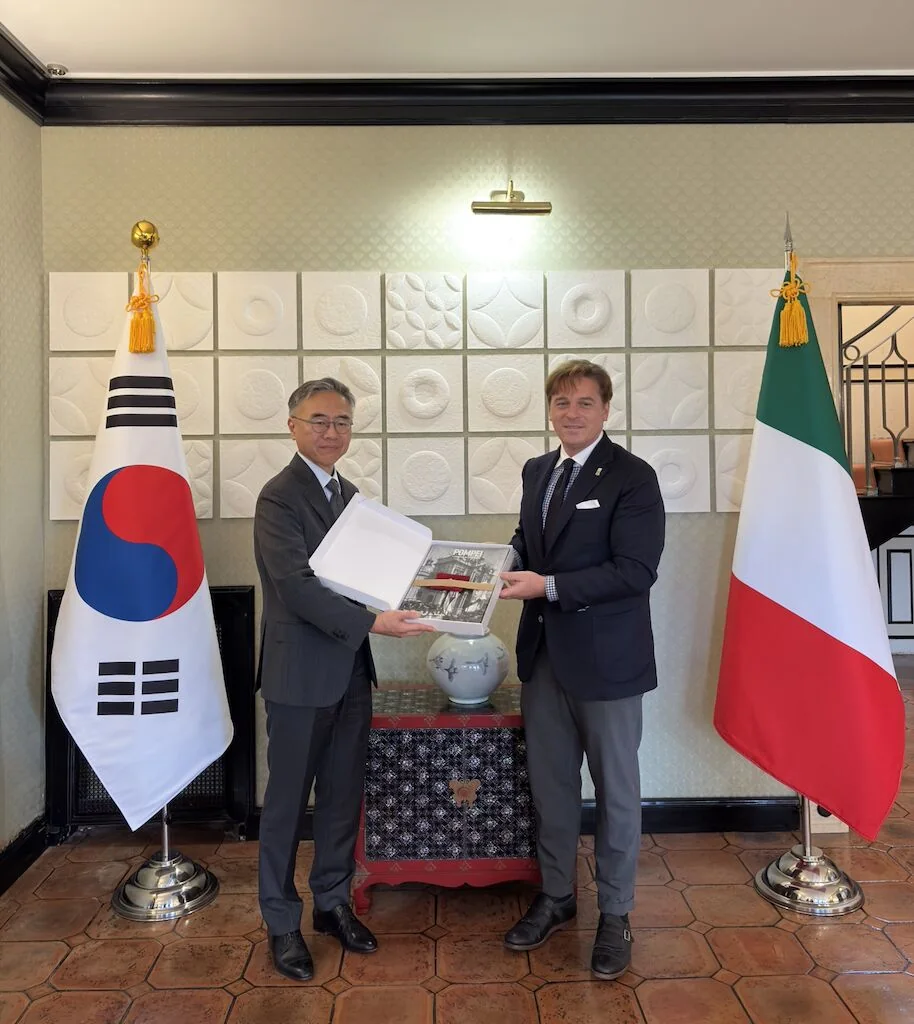
After the official photograph
International relations are often told through their most visible moments: an official visit, a signature, two flags, a photograph. These moments matter. But the value of a relationship begins above all with what happens afterwards.
When I meet an international counterpart, the most useful question is not only whom we can invite or what ceremony we can organise. It is another: what concrete value can arise from bringing two territories together? Which relationships already exist but have not yet been connected? And which new opportunities can be built from those connections?
Korea and Abruzzo are interesting precisely for this reason: not because they need to look alike, but because their competences and vocations can become complementary.
Do not start from zero
One of the most useful lessons in international relations is that we rarely start from zero. Before imagining new projects, we should recognise what already exists.
Scientific links, university relationships, trade flows and the broader bilateral framework between Italy and the Republic of Korea already provide foundations on which to build.
The relationship, therefore, does not need to be invented. It needs to be recognised, connected and developed.
From research to space
Abruzzo possesses a striking combination. Beneath Gran Sasso, researchers explore some of the fundamental questions of the universe; in Fucino, we communicate with what orbits above the Earth.
Scientific research, satellite technologies, telecommunications, cybersecurity, artificial intelligence and training can become fields of conversation with one of the world's most technologically advanced economies.
Territorial diplomacy should not replace universities, companies or research centres. Its task is to create the point of contact.
Industry, universities, people
The same applies to industry. Val di Sangro is one of central Italy's major manufacturing areas. The interesting question is not only how to sell more, but where industrial competences, technologies and supply chains can meet.
Universities perform a special function: they can turn an institutional relationship into a generational one. Student mobility, joint research, doctoral programmes, faculty exchanges and university–business connections can outlast a single visit.
A relationship becomes stable when it no longer depends only on the people who started it, but begins to create new people capable of continuing it.
The mountain as expertise
Roccaraso and Alto Sangro add another dimension. A mountain is not only tourism. It is a system of expertise: ski instruction, safety, avalanche prevention, snowmaking, environmental management, resort operations, youth sport and hospitality.
A dialogue with PyeongChang can therefore be understood not simply as a relationship between ski destinations, but as a possible exchange between territories that have developed specific knowledge around mountains and winter sports.
What remains
Territorial diplomacy does not replace state diplomacy. It works when it operates within bilateral relations and turns a national framework into concrete local opportunities.
A visit should therefore not be judged only by what happens during those hours. The more important question is what continues afterwards: a call, a university meeting, a company finding a partner, an exchange programme, a training project.
A relationship begins with an introduction. A partnership requires continuity. And continuity turns opportunity into cooperation.